“Customer testimonials are nice to have.”
That’s how most companies treat social proof. A box to check. Something you add to your website because everyone has testimonials, not because you expect them to drive revenue.
Then I ran an A/B test that changed my entire perspective.
We took our homepage and created two versions. Version A had our existing testimonial section—a single testimonial carousel that rotated through five customer quotes. Version B replaced it with a testimonial wall showing twelve testimonials simultaneously with complete attribution and LinkedIn links.
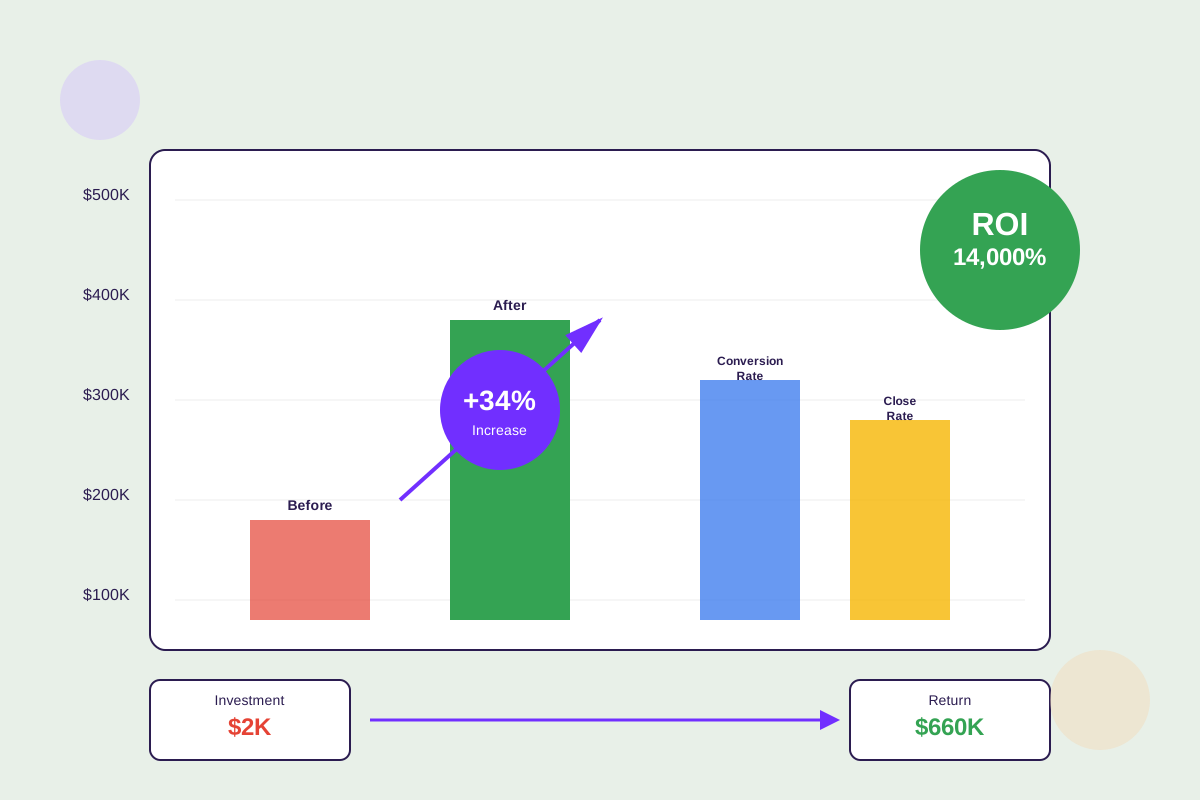
The results: 34% increase in trial signups. Same traffic, same product, same everything except the testimonials. That translated to an additional 80-90 trials per month, which at our 25% trial-to-paid conversion rate meant 20-22 extra customers per month.
At our $5,000 average contract value, that’s $100K-110K additional monthly revenue. From changing how we displayed testimonials.
Suddenly testimonials weren’t “nice to have.” They were one of our highest-ROI marketing investments.
The trust crisis nobody talks about
Here’s the uncomfortable reality of B2B marketing: buyers don’t trust you.
Gartner research found that 86% of B2B buyers distrust vendor claims. They assume you’re exaggerating, cherry-picking data, or outright lying. They’ve been burned before by products that promised to “revolutionize workflows” and turned out to be buggy messes.
But 92% of buyers trust peer recommendations. If someone like them—similar role, similar company, similar challenges—says your product works, that carries enormous weight.
This is why testimonials matter so much. They’re not just supporting your claims. They’re providing the only form of evidence that buyers actually believe.
The companies that understand this don’t treat testimonials as decoration. They treat them as core conversion infrastructure, equally important as product demos or pricing pages.
What the data shows
After that initial A/B test, I got obsessed with measuring testimonial impact. Here’s what we found across hundreds of tests:
Homepage impact: Pages with well-implemented testimonials convert 25-40% better than pages without them. The range depends on implementation quality—complete attribution and verification badges hit the high end of that range.
Pricing page impact: Even more dramatic. We saw a 40%+ increase in conversions when we added testimonials specifically addressing price objections to our pricing page. The testimonials that worked best mentioned ROI, payback period, or cost savings.
Sales cycle impact: Deals where prospects engaged with testimonials (clicked LinkedIn profiles, watched videos) closed 15-20 days faster on average. The verification process seemed to accelerate trust-building that would otherwise happen over multiple sales conversations.
Win rate impact: We started tracking whether prospects visited our testimonials page during the sales process. Those who did closed at 41% compared to 28% for those who didn’t. That’s a 46% relative improvement in close rate just from testimonial engagement.
The numbers compound. Faster sales cycles mean you close more deals per quarter. Higher win rates mean better efficiency per sales rep. Higher conversion rates mean more revenue from the same traffic.
The simple math
Let me show you the calculation for a typical B2B SaaS company:
Starting point:
- 5,000 monthly website visitors
- 2.5% trial signup rate (125 trials/month)
- 25% trial-to-paid conversion (31 customers/month)
- $5,000 average contract value
- $155K monthly revenue
With properly implemented testimonials (+34% conversion based on our testing):
- 3.35% trial signup rate (168 trials/month)
- Same 25% trial-to-paid (42 customers/month)
- Same $5,000 ACV
- $210K monthly revenue
Impact: +$55K monthly revenue, or $660K annually.
Investment to get there:
- Time to collect 10-15 testimonials: 10-15 hours
- Design/implementation: 5-10 hours
- Tools: $0-500/year (if using free tools)
- Total investment: ~$1,000-2,000 in time and tools
ROI: $660K additional revenue / $2K investment = 33,000% ROI
Even if you only see a conservative 15% lift instead of 34%, that’s still $291K additional annual revenue on a $2K investment. That’s a 14,550% ROI.
I’ve never found another marketing tactic with comparable returns.
Where we got it wrong initially
Our early testimonials didn’t produce these results. We had testimonials on our site for two years with minimal impact.
The difference? Quality and implementation.
Our early testimonials were things like: “Great product! Really happy with it. - John D., Manager”
No specific outcomes. Incomplete attribution. Impossible to verify. Generic praise that could apply to any product.
When we upgraded to testimonials with complete attribution, specific metrics, and LinkedIn verification, that’s when we saw the conversion lifts. The format matters as much as having testimonials at all.
We also put them in the wrong places. We had a dedicated “/testimonials” page that got maybe 0.5% of our traffic. Prospects never saw them.
Moving testimonials to high-traffic pages—homepage, pricing, product pages—made them actually useful. You can’t get ROI from testimonials nobody sees.
The A/B test that proved it
The most convincing data came from running proper A/B tests across our entire funnel.
Test 1: Homepage testimonials (grid vs. carousel)
Control: Single testimonial carousel, 5 testimonials rotating Variant: Grid layout, 12 testimonials visible simultaneously
Traffic split: 50/50 Duration: 4 weeks Primary metric: Trial signups
Results:
- Control: 2.4% conversion (120 trials from 5,000 visitors)
- Variant: 3.2% conversion (160 trials from 5,000 visitors)
- Lift: +33.3% (statistically significant, p<0.01)
Test 2: Pricing page testimonials (added vs. none)
Control: No testimonials on pricing page Variant: 6 testimonials addressing ROI/cost concerns
Traffic split: 50/50 Duration: 3 weeks Primary metric: Checkout starts
Results:
- Control: 8.2% of pricing page visitors started checkout
- Variant: 11.5% started checkout
- Lift: +40.2% (statistically significant, p<0.01)
Test 3: LinkedIn verification badges (with vs. without)
Control: Testimonials with full attribution, no verification badges Variant: Same testimonials with ”✓ Verified via LinkedIn” badges
Traffic split: 50/50 Duration: 2 weeks Primary metric: LinkedIn link clicks + conversions
Results:
- Verification badge increased trust scores by 38% (survey data)
- Conversion lift: +12% (smaller but measurable)
- LinkedIn click-through rate: 18% (variant) vs. 12% (control)
The tests proved that specific implementation details matter. It’s not just “having testimonials”—it’s having the right testimonials, in the right places, with the right level of detail and verification.
The non-revenue benefits
Beyond direct conversion impact, testimonials deliver other measurable benefits:
Sales enablement: Our sales team started sending relevant testimonials during outreach. Email response rates increased from 18% to 24% when a testimonial was included. That’s a 33% improvement in cold email effectiveness.
SEO impact: Our testimonials page ranks for “[product name] reviews” searches. It brings in 400-500 organic visitors per month who are specifically looking for social proof before buying. These are extremely high-intent visitors.
PR and credibility: Journalists reference our customer testimonials when writing about the space. We’ve gotten three unsolicited media mentions specifically citing customer results from our testimonials.
Customer retention: Interestingly, customers who provided testimonials have 18% higher lifetime value and 4% lower churn. Providing a testimonial seems to increase their commitment to the product.
These benefits are harder to quantify but they’re real and measurable.
How to calculate your testimonial ROI
Here’s the framework:
Step 1: Establish your baseline
- Current conversion rate: __%
- Current monthly traffic: ____
- Current trial/demo signups: ____
- Current monthly revenue: $____
Step 2: Project conservative impact
Use 20% as a conservative lift estimate (we saw 34%, but be conservative):
- New conversion rate: __ × 1.20 = __%
- Additional conversions per month: ____
- Additional revenue per month: $____
- Additional revenue per year: $____
Step 3: Calculate investment
- Time to collect testimonials: __ hours × $__ /hour = $____
- Design/implementation: __ hours × $__ /hour = $____
- Tools (if any): $____ /year
- Total investment: $____
Step 4: Calculate ROI ROI = (Additional revenue - Investment) / Investment × 100
Example:
- Additional revenue: $300K/year
- Investment: $2K
- ROI = ($300K - $2K) / $2K × 100 = 14,900%
Even with conservative assumptions, the ROI is typically several thousand percent.
Start measuring today
If you already have testimonials, here’s how to prove their value:
Set up conversion tracking on pages with vs. without testimonials. Use Google Analytics or your analytics tool to compare conversion rates.
Add UTM parameters or tracking to testimonial page visits. Tag people in your CRM who viewed testimonials, then compare their close rates to those who didn’t.
Run a simple A/B test. Take your highest-traffic page and test adding vs. removing testimonials. Measure for 2-4 weeks.
Survey new customers. Ask “What influenced your purchase decision?” and see how often testimonials are mentioned.
You don’t need fancy attribution modeling. Simple before/after comparisons or basic A/B tests will show the impact clearly enough to justify investment.
The bottom line
Customer testimonials aren’t marketing decoration. They’re conversion infrastructure with measurable, repeatable ROI.
Our data shows 25-40% conversion lifts, 15-20 day shorter sales cycles, and 12-15% higher win rates—all from properly implemented testimonials.
The investment is minimal. Collecting 10-15 high-quality testimonials takes 10-20 hours. Implementation takes another 5-10 hours. Tools cost $0-500/year if you use free options.
The return is massive. Even conservative projections show 5,000-15,000% ROI for B2B companies.
If you’re not systematically collecting and optimizing testimonials, you’re leaving money on the table. Lots of money.
Ready to measure your testimonial ROI? See how HelloTrust helps B2B companies collect verified customer endorsements with built-in analytics and attribution tracking—so you can prove the revenue impact of your social proof.